
KING DINUZULU COMMEMORATION CEREMONY
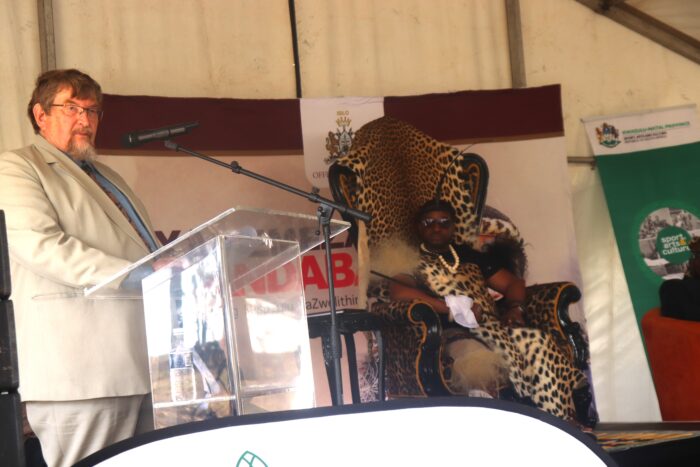
Opinion Piece by Dr Graham Dominy, a former Council member who represented the NHC at the ceremony
MIDDELBURG MPUMALANGA
The National Heritage Council (NHC) was invited to participate in an event on Rietfontein Farm, near Middelburg in Mpumalanga on 18th October 2024 to commemorate the death of King Dinuzulu ka Cetshwayo at the farm in 1913.
The event was co-hosted by the KwaZulu-Natal Provincial Premier’s Office, KZN Amafa, the Zulu Royal Household and the Afrikaans cultural organisation, AfriForum. It was supported by the Mpumalanga Provincial Government and the NHC. His Majesty King Misuzulu ka Zwelithini graced the occasion and was welcomed to Mpumalanga by the Provincial MEC for Sport, Arts and Culture, Ms Leah Mabuza. This is the first time that this historic commemoration has received such high official recognition. It was an honour for the NHC to be invited by the KZN Amafa Research Institute (the PHRA for KZN) to address the occasion on the historical significance of the event.
The event was of high significance for two main reasons, one historical and modern. In the first instance the event was historically important because King Dinuzulu ka Cetshwayo son of Cetshwayo ka Mpande, the last king of an independent Zulu kingdom was proclaimed king after his father’s death in 1884. He needed the Boers help to secure his throne and that came at a price. The price to pay was the land on which the Boers established the town of Vryheid and a lot of farms as well.
One of the key figures among the Boers at the time was young Louis Botha, who was a fluent in Zulu, a linguist and a born leader, even in his early twenties. Dinuzulu was sixteen at the time when he first met Botha, who was playing a crucial part in organising the new king’s coronation ceremony. After the ceremony the two young men fought together against Zibhebhu, the leader of Mandlakazi who were very hostile to the new king. The Battle of Etshaneni was the first time the two young men had been in combat. Louis Botha was then appointed by the Boer authorities in Vryheid as one of the Surveyors of the new farms on the land that had been taken from the Zulus.
Many historians have claimed that Botha did this because of his old friendship with Dinuzulu, but I believe that this was a highly political decision. Botha was demonstrating that South Africa had a new master with a new policy, and he wanted to gain support from black South Africans, the whites as well as the British Government. Dinuzulu was allocated the farm, Rietfontein, on the highveld of the then Transvaal. He then named the farm “KwaThengisangaye” (which translates as “Barter with Him”). His wives were allowed to join him and the ladies visited Mrs Botha, the Prime Minister’s wife, to pass on their thanks for the release of their husband. They all had tea together.
Historians say that Dinuzulu lived quietly until his premature death from illness in 1913. This is not entirely true. He received many visitors and went to Johannesburg to meet Zulu miners on the gold mines. He also came to Pretoria to campaign for General Botha in the general elections for the first Parliament of the Union of South Africa. There was also political controversy over whether to allow him to travel to Germany for treatment as his health deteriorated. Dinuzulu died on 18 October 1913 before the government had decided on letting him travel to Germany. Louis Botha ordered that the king’s remains should be returned to Zululand to be buried in the Emakhosini valley, the Valley of the Kings, where Dinuzulu’s royal ancestors were buried. The objections of the Natal Provincial authorities were ignored.
In the year before he died, King Dinuzulu was elected an honorary life president of the South African Native National Congress, the forerunner of the ANC. So, a former king became an inspiration for Africa’s first and founding liberation movement.
Let me turn to the importance of this event in modern times. In 2023, the event was sponsored by Afrikaner and Zulu cultural organisations, working together without official support, but an interesting cross-cultural community initiative. In 2024 it received official recognition from the national government, via the NHC, and from the provincial governments in Mpumalanga and KwaZulu-Natal. It is an initiative that promotes social cohesion and national unity, around an important historical and heritage theme. The presence of King Misuzulu raised the status of the occasion and foregrounded the type of traditional cultural practices that the NHC attempts to preserve and encourage.
I think the way forward now should be for the site and the graves of Dinuzulu’s followers who are buried there, to receive official protection. Mpumalanga, KZN, SAHRA and the NHC can all play an important role in this. A full heritage, historical and archaeological survey of the site would be a good start.